Estimación de tallas de anchoveta (Engraulis ringens) mediante ecosonda en áreas pesqueras de difícil acceso en la Región de Atacama, Chile
DOI:
https://doi.org/10.25268/bimc.invemar.2025.54.2.1321Palabras clave:
Pelágico, anchoveta, pesquerías, monitoreo, ecosondaResumen
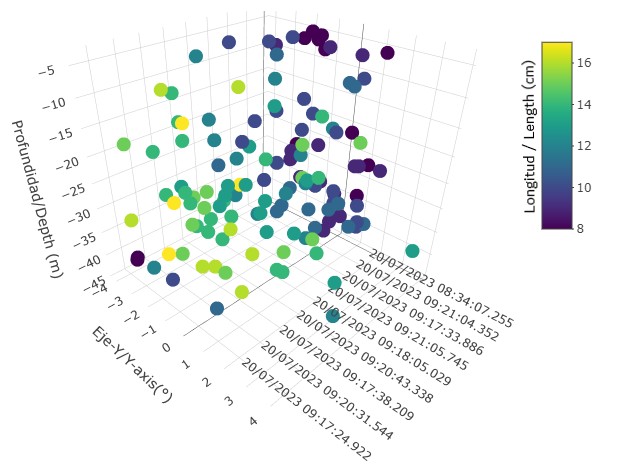
Este estudio explora el uso de métodos hidroacústicos para estimar la distribución de las longitudes de anchovetas, ofreciendo una alternativa a los métodos tradicionales de muestreo biológico. Se recolectaron datos acústicos utilizando dos algoritmos: Single Target y Tracked Target, junto con un modelo de conversión de TS a longitud específico para anchoveta. Los resultados mostraron que el algoritmo Single Target estimó tamaños de 8,5 a 16 cm, con una moda de 12,0 cm, mientras que el algoritmo Tracked Target identificó un rango de 9 a 14 cm, con una moda de 11,5 cm. Las anchovetas juveniles representaron el 45,8% y el 51,2% de la población en cada algoritmo. Además, la profundidad de los ecos osciló entre 3,92 y 43,95 m, lo que sugiere que las anchovetas de mayor longitud tienden a habitar zonas costeras más profundas, posiblemente como una adaptación fisiológica a estos ambientes. El estudio demuestra la efectividad de la hidroacústica para estimar las tallas de peces, especialmente en áreas donde el muestreo tradicional es inaccesible o difícil de llevar a cabo. Este enfoque contribuye a comprender la dinámica de las poblaciones de peces y abre la puerta a futuros
estudios.
Referencias
Alheit, J. and Niquen, M. (2004). Regime shifts in the Humboldt Current ecosystem. Progress in Oceanography, 60(2-4), pp.201–222. https://doi.org/10.1016/j.pocean.2004.02.006
Báez, J.C., Gimeno, L. and Real, R. (2021). North Atlantic Os- cillation and Fisheries Management during Global Climate Change. Reviews in Fish Biology and Fisheries, 31, pp. 319–336. https://doi.org/10.1007/s11160-021-09645-z
Balk, H. and Lindem, T. (2000). Amélioration des détections de poissons à partir des données de sonar à double faisceau. Aquatic Living Resources, 13(5), pp. 297–303. https://doi. org/10.1016/s0990-7440(00)01079-2
Bassett, C., De Robertis, A. and Wilson, C.D. (2018). Broad- band echosounder measurements of the frequency re- sponse of fishes and euphausiids in the Gulf of Alaska. ICES Journal of Marine Science, 75(3), pp. 1131–1142. https://doi.org/10.1093/icesjms/fsx204
Benoit‐Bird, K.J. and Waluk, C.M. (2020). Exploring the prom- ise of broadband fisheries echosounders for species dis- crimination with quantitative assessment of data process- ing effects. Journal of the Acoustical Society of America, 147(1), pp. 411–427. https://doi.org/10.1121/10.0000594
Bertrand, A., Gerlotto, F., Bertrand, S., Gutiérrez, M., Alza, L., Chipollini, A., Díaz, E., Espinoza, P., Ledesma, J., Ques- quén, R., Peraltilla, S. and Chavez, F. (2008). Schooling behaviour and environmental forcing in relation to an- choveta distribution: An analysis across multiple spatial scales. Progress in Oceanography, 79(2), pp. 264–277. https://doi.org/10.1016/j.pocean.2008.10.018
Bertrand, A., Segura, M., Gutierrez, M. and Vasquez, L. (2004). From small-scale habitat loopholes to decadal cycles: a habitat-based hypothesis explaining fluctua- tion in pelagic fish populations off Peru. Fish and Fisher- ies, 5(4), pp. 296–316. https://doi.org/10.1111/j.1467- 2679.2004.00165.x
Boswell, K.M., Wilson, M.P. and Wilson, C.A. (2007). Hy- droacoustics as a tool for assessing fish biomass and size distribution associated with discrete shallow water estua- rine habitats in Louisiana. Estuaries and Coasts, 30(4), pp. 607–617. https://doi.org/10.1007/BF02841958
Canales, C.M., Adasme, N.A., Cubillos, L.A., Cuevas, M.J. and Nazareth Sánchez (2018). Long-time spatio-temporal vari- ations in anchovy (Engraulis ringens) biological traits off northern Chile: an adaptive response to long-term environ- mental change? ICES Journal of Marine Science, 75(6), pp.1908–1923. https://doi.org/10.1093/icesjms/fsy082
Castillo, J., Saavedra, A., Leiva, F., Legua, J., La Cruz, L., Alegría, N., Núñez, S., Silva, J. and Sepulveda, A. (2022). Estimación de la fuerza de blanco (TS) para las unidades demográficas de anchoveta a nivel nacional 2020-2019. Chile: Instituto de Fomento Pesquero, p.170.
Castillo, P.R., Ñiquen, M., Cruz, L.L., Guevara-Carrasco, R. and Cuadros, G. (2021). Migration behavior of anchoveta (Engraulis ringens) in the Northern Humboldt Current Sys- tem between September 2019 and September 2020. Latin American Journal of Aquatic Research, 49(5), pp.702–716. http://dx.doi.org/10.3856/vol49-issue5-fulltext-2669
Chavez, F.P. and Messié, M. (2009). A comparison of Eastern Boundary Upwelling Ecosystems. Progress in Ocean- ography, 83(1-4), pp.80–96. https://doi.org/10.1016/j. pocean.2009.07.032
Chu, D. (2011). Technology evolution and advances in fisher- ies acoustics. Journal of Marine Science and Technology, 19(3). https://doi.org/10.51400/2709-6998.2188
De Robertis, A. and Higginbottom, I. (2007). A post-processing technique to estimate the signal-to-noise ratio and remove echosounder background noise. ICES Journal of Marine Science, 64(6), pp.1282–1291. https://doi.org/10.1093/ icesjms/fsm112
Demer, D.A., Berger, L., Bernasconi, M., Bethke, E., Bo- swell, K., Chu, D., Domokos, R., Dunford, A., Fassler, S., Gauthier, S., Hufnagle, L.T., Jech, J.M., Bouffant, N., Lebourges-Dhaussy, A., Lurton, X., Macaulay, G.J., Perrot, Y., Ryan, T., Parker-Stetter, S. and Stienessen, S. (2015). Calibration of acoustic instruments. International Council for the Exploration of the Sea (ICES) Copenhagen, Denmar, Copenhagen, Denmar: International Council for the Exploration of the Sea (ICES) C, p.133. http://dx.doi. org/10.25607/OBP-185
Doray, M., Berger, L., Le Bouffant, N., Yves Coail, J., Vacherot, J.-P., De La Bernardie, X., Morinière, P., Lys, E., Schwab,R. and Petitgas, P. (2016). A method for controlled target strength measurements of pelagic fish, with application to European anchovy (Engraulis encrasicolus). Ices Journal of Marine Science, 73(8), pp.1987–1997. https://doi. org/10.1093/icesjms/fsw084
Foote, K.G. (1987). Fish target strengths for use in echo integrator surveys. The Journal of the Acoustical So- ciety of America, 82(3), pp. 981–987. https://doi. org/10.1121/1.395298.
Ganais, K. (2014). Biology and ecology of sardines and ancho- vies. CRC Press, p. 394.
Garcés, C., Niklitschek, E.J., Plaza, G., Cerna, F., Leisen, M., Toledo, P. and Barra, F. (2019). Anchoveta Engraulis ringens along the Chilean coast: Management units, demographic units and water masses: Insights from multiple otolith‐based approaches. Fisheries Oceanography, 28(6), pp.735–750. https://doi.org/10.1111/fog.12455.
Gibson, R.N., Atkinson, A. and Gordon (2016). Oceanog- raphy and Marine Biology. 1st ed. [online] CRC Press. Available at: https://www.taylorfrancis.com/chapters/ edit/10.1201/9781420094220-9/review-underwater-stereo- image-measurement-marine-biology-ecology-applications- mark-shortis-euan-harvey-dave-abdo .
Gutiérrez, M., Swartzman, G., Bertrand, A. and Bertrand, S. (2007). Anchovy (Engraulis ringens) and sardine (Sardinops sagax) spatial dynamics and aggregation patterns in the Humboldt Current ecosystem, Peru, from 1983?2003. Fisheries Oceanography, 16(2), pp. 155–168. https://doi.org/10.1111/j.1365-2419.2006.00422.x
Gutiérrez, T.M., Castillo, P.J., Naranjo, B.L. and Akester, M.J. (2017). Current state of goods, services and governance of the Humboldt Current Large Marine Ecosystem in the context of climate change. Environmental Develop- ment, 22, pp. 175–190. https://doi.org/10.1016/j.en- vdev.2017.02.006
Harrison, D.E. and Chiodi, A.M. (2015). Multi-decadal vari- ability and trends in the El Niño-Southern Oscillation and tropical Pacific fisheries implications. Deep Sea Research Part II: Topical Studies in Oceanography, 113, pp. 9–21. https://doi.org/10.1016/j.dsr2.2013.12.020
Hasegawa, K., Yan, N. and Mukai, T. (2021). In situ broadband acoustic measurements of age-0 walleye pollock and pointhead flounder in Funka Bay, Hokkaido, Japan. Jour- nal of marine science and technology, 29(2). https://doi. org/10.51400/2709-6998.1076
Hazen, E.L. and Horne, J.K. (2003). A method for evaluating the effects of biological factors on fish target strength. ICES Journal of Marine Science, 60(3), pp. 555–562. https://doi.org/10.1016/S1054-3139(03)00053-5
Hernández-Santoro, C., Landaeta, M.F. and Jorge Castillo Pizarro (2018). Effect of ENSO on the distribution and con- centration of catches and reproductive activity of anchovy Engraulis ringens in northern Chile. Fisheries Oceanogra- phy, 28(3), pp. 241–255. https://doi.org/10.1016/S1054-3139(03)00053-5
Hesterberg, T. (2011). Bootstrap. Wiley Interdisciplinary Reviews: Computational Statistics, 3(6), pp. 497–526. https://doi.org/10.1002/wics.182
Hilborn, R. and Walters, C.J. (2013). Quantitative Fisheries Stock Assessment. Springer eBooks, 3(6), p. 570. https:// doi.org/10.1007/978-1-4615-3598-0
Hinchliffe, C., Kuriyama, P.T., Punt, A.E., Field, J.C., Thomp- son, A.R., Santora, J.A., Muhling, B.A., Koenigstein, S., Hernvann, P.-Y. and Tommasi, D. (2025). Long-term popu- lation trend of northern anchovy (Engraulis mordax) in the California Current system. ICES Journal of Marine Sci- ence, 82(1). https://doi.org/10.1093/icesjms/fsae177
IFOP (2025). Programa de seguimiento de las principales pesquerías pelágicas de la zona norte de Chile, entre la Región Arica– Parinacota y Coquimbo, año 2024. Subsec- retaría de Economía y EMT / febrero 2025. IFOP, p. 15.
Knudsen, H.P. (2006). Gauging the Reliability of Acoustic Instruments for Fisheries Surveys. Oceans, 69, pp. 1–6. https://doi.org/10.1109/OCEANS.2006.307044
Korneliussen, R.K. (2018). Fifty years of marine tag recoveries from Atlantic salmon. ICES Cooperative Research Report, 343, p. 110. https://doi.org/10.17895/ices.pub.4542
Kubilius, R., Bergès, B. and Macaulay, G.J. (2023). Remote acoustic sizing of tethered fish using broadband acous- tics. Fisheries Research, 260, p.106585. https://doi. org/10.1016/j.fishres.2022.106585
Kubilius, R., Macaulay, G.J. and Ona, E. (2020). Remote siz- ing of fish-like targets using broadband acoustics. Fisher- ies Research, 228, p.105568. https://doi.org/10.1016/j.fishres.2020.105568
Ladroit, Y., Escobar-Flores, P.C., Schimel, A.C.G. and O’Driscoll, R.L. (2020). ESP3: An open-source software for the quantitative processing of hydro-acoustic data. SoftwareX, 12, p. 100581. https://doi.org/10.1016/j. softx.2020.100581
Letessier, T.B., Proud, R., Meeuwig, J.J., Cox, M.J., Hosegood, P.J. and Brierley, A.S. (2021). Estimating Pelagic Fish Biomass in a Tropical Seascape Using Echosounding and Baited Stereo-Videography. Ecosystems, 25(6), pp. 1400–1417. https://doi.org/10.1007/s10021-021-00723-8
Loranger, S., Jech, M.J. and Lavery, A.C. (2022). Broadband acoustic quantification of mixed biological aggregations at the New England shelf break. The Journal of the Acousti- cal Society of America, 152(4), pp. 2319–2335. https://doi. org/10.1121/10.0014910
Love, R.H. (1971). Measurements of fish target strength: a review. Fishery Bulletin, 69(4), pp. 703–715.
Love, R.H., Fialkowski, J.M. and Jagielo, T.H. (2016). Target strength distributions of Pacific sardine schools: Model results at 500 Hz to 10 kHz. The Journal of the Acoustical Society of America, 140(6), pp. 4456–4471. https://doi. org/10.1121/1.4966553
Maclennan, D., Fernandes, P. and Dalen, J. (2002). A con- sistent approach to definitions and symbols in fisheries acoustics. ICES Journal of Marine Science, 59(2), pp. 365–369. https://doi.org/10.1006/jmsc.2001.1158
Nielsen, J. and Lundgren, B. (1999). Hydroacoustic ex situ target strength measurements on juvenile cod (Gadus morhua L.). ICES Journal of Marine Science, 56(5), pp. 627–639. https://doi.org/10.1006/jmsc.1999.0515
Ñiquen, M. and Bouchon, M. (2004). Impact of El Niño events on pelagic fisheries in Peruvian waters. Deep Sea Re- search Part II: Topical Studies in Oceanography, 51(6-9), pp. 563–574. https://doi.org/10.1016/j.dsr2.2004.03.001
Ona, E. (1999). Methodology for Target Strength measure- ments (With special reference to in situ techniques for fish and mikro-nekton). ICES Cooperative Research Report, 235(65), p. 35. https://doi.org/10.17895/ices.pub.5367
Ortiz, M. (2020). Pre-image population indices for anchovy and sardine species in the Humboldt Current System off Peru and Chile: Years decaying productivity. Ecologi- cal Indicators, 119, p. 106844. https://doi.org/10.1016/j. ecolind.2020.106844
Øvredal, J.T. and Totland, B. (2002). The scantrol FishMe- ter for recording fish length, weight and biological data. Fisheries Research, 55(1-3), pp. 325–328. https://doi. org/10.1016/S0165-7836(01)00274-0.
Palermino, A., De Felice, A., Canduci, G., Biagiotti, I., Costan- tini, I., Centurelli, M. and Leonori, I. (2023). Application of an analytical approach to characterize the target strength of ancillary pelagic fish species. Scientific Reports, 13(1). https://doi.org/10.1038/s41598-023-42326-4
Reid, R.G. (2000). Report on echo trace classification. ICES Cooperative Research Report, 238, p. 155.
Robotham, H., Bosch, P., Gutiérrez-Estrada, J.C., Castillo, J. and Inmaculada Pulido-Calvo (2009). Acoustic identifica- tion of small pelagic fish species in Chile using support vector machines and neural networks. Fisheries Re- search, 102(1-2), pp. 115–122. https://doi.org/10.1016/j. fishres.2009.10.015
RStudio, T. (2020). Rstudio: integrated development for r. Rstudio Team. [online] rstudio.com. Available at: http:// www.rstudio.com
Ryan, T.E., Downie, R.A., Kloser, R.J. and Keith, G. (2015). Reducing bias due to noise and attenuation in open-ocean echo integration data. ICES Journal of Marine Science, 72(8), pp. 2482–2493. https://doi.org/10.1093/icesjms/ fsv121
Sawada, K., Furusawa, M. and Williamson, N.J. (1993). Condi- tions for the precise measurement of fish target strength in situ. The Journal of The Marine Acoustics Society of Ja- pan, 20(2), pp. 73–79. https://doi.org/10.3135/jmasj.20.73
Simmonds, J. and MacLennan , D. (2025). Fisheries acoustics: Theory and practice. Fish and Aquatic Resources. [online] https://books.google.cl/books?id=1w5LiIr3NdoC. Available at: https://books.google.cl/books?id=1w5LiIr3NdoC
Soule, M., Barange, M., Haakon Solli and Hampton, I. (1997). Performance of a new phase algorithm for discriminating between single and overlapping echoes in a split-beam echosounder. ICES Journal of Marine Science, 54(5), pp. 934–938. https://doi.org/10.1006/jmsc.1997.0270
Descargas
Publicado
Número
Sección
Licencia
Derechos de autor 2025 Luis Angel La Cruz Aparco, Cristián Henríquez-Pastene, Adrian Ibieta, Francisco Leiva-Dietz

Esta obra está bajo una licencia internacional Creative Commons Atribución-NoComercial-CompartirIgual 4.0.