Age, growth and length–weight relationship of Echiophis brunneus inthe Ecuadorian Pacific: A Bayesian multimodel approach
DOI:
https://doi.org/10.25268/bimc.invemar.2026.55.2.1363Keywords:
Age and growth, multimodel analysis, Bayesian statistics, sagittal otoliths, length– weight relationshipAbstract
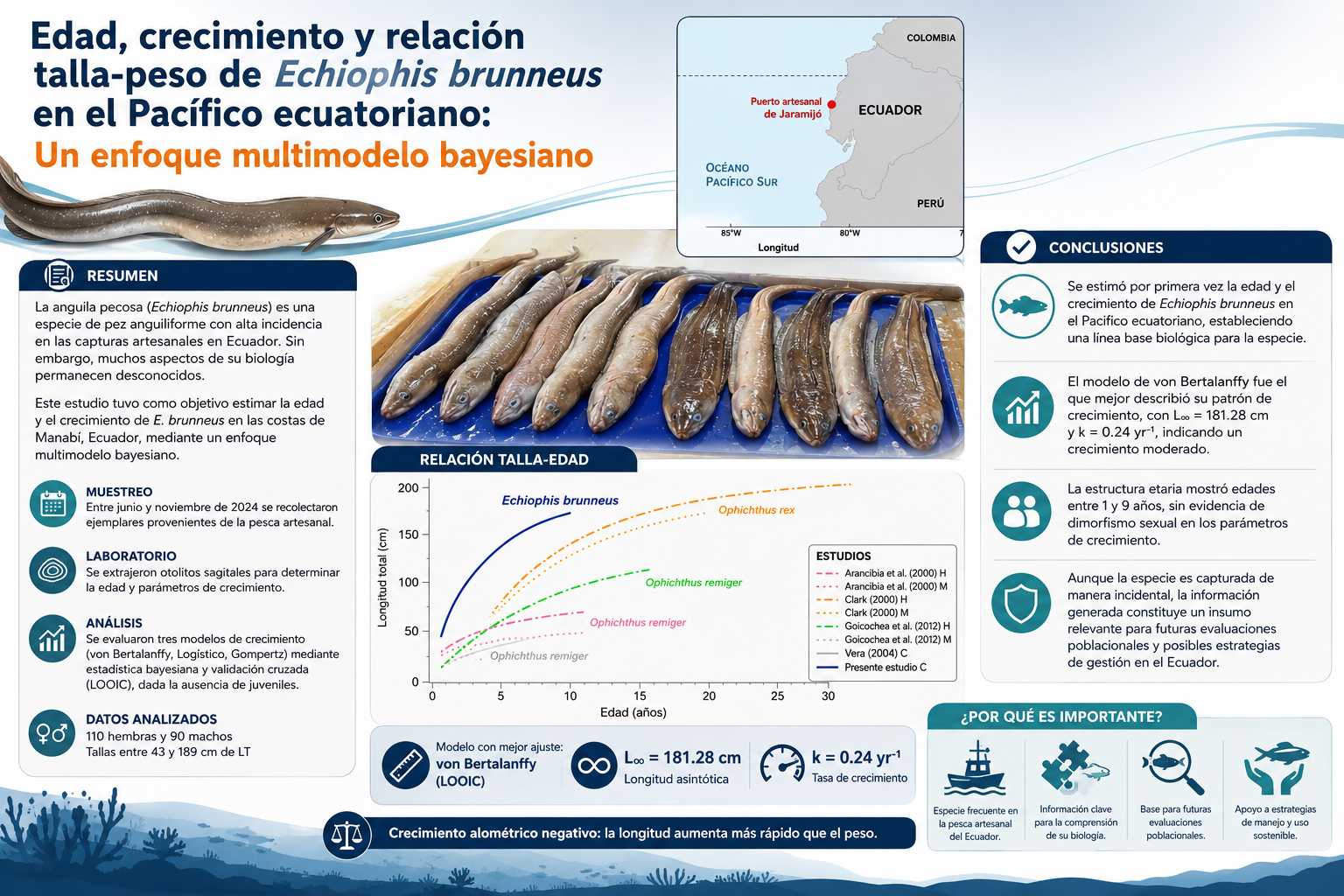
The speckled worm eel (Echiophis brunneus) is an anguilliform fish species with a high incidence in artisanal catches in Ecuador. However, globally, many aspects of its biology remain unknown. This study aimed to estimate age and growth within the population structure of E. brunneus along the coast of Manabí, Ecuador. Between June and November 2024 specimens
were collected from artisanal fisheries. In the laboratory, sagittal otoliths were extracted to determine age and growth parameters through a multimodel analysis (von Bertalanffy, Logistic, Gompertz) using Bayesian statistics, given the absence of juveniles in the sample. A total of 110 females and 90 males were analysed, with total lengths ranging from 43 to 189 cm TL. The results indicated negative allometric growth, with estimated ages ranging from 1 to 9 years. The von Bertalanffy model provided the best fit according to the cross-validation criterion (LOOIC), yielding estimates of L∞ = 181.28 cm and k = 0.24 yr-¹. The growth pattern reflects a faster increase in length than in weight, indicating slow to moderate growth and a moderate asymptotic length. These findings provide a biological baseline that may be used in future fisheries assessments and population studies of the species.
References
Arancibia, H., Alarcón, L., Caballero, R., Concha, R. y Carmona, A. (2000).
Nuevas pesquerías para Chile Central. Anguila común (Ophichthus pacifici).
Proyecto FONDEF D97I-1058. Desarrollo de nuevas pesquerías de recursos
marinos bentónicos, pelágicos y demersales en Chile Central. Documento
Técnico Nº3, UNITED, Departamento de Oceanografía, Universidad de
Concepción.
Barua, S., Liu, Q., Alam, M. S., Schneider, P., Mozumder, M. M. H. and Rouf, M.
A. (2023). Population dynamics and stock assessment of two major eels
(Muraenesox bagio and Congresox talabonoides) from the marine waters
of Bangladesh. Frontiers in Marine Science, 10. doi: https://doi.org/10.3389/
fmars.2023.1134343
Beamish, R. J. and Fournier, D. A. (1981). A method for comparing the precision
of a set of age determinations. Canadian Journal of Fisheries and Aquatic
Sciences, 38(8), pp. 982–983. doi: https://doi.org/10.1139/f81-132
Berg, L. S. (1958). System der rezenten und fossilen Fischartigen und Fische.
Berlin: VEB Verlag der Wissenschaften, p. 311.
Beverton, R.J.H. and Holt, S.J. (1957). On the dynamics of exploited fish
populations. London: Chapman and Hall, p. 533.
Breaker, L.C., Loor, H. and Carroll, H. (2016). Trends in sea surface temperature
off the coast of Ecuador and the major processes that contribute to them.
Journal of Marine Systems, 164: pp. 151-164. doi: https://doi.org/10.1016/j.
jmarsys.2016.09.002
Buragohain, A. and Goswami, M. M. (2014). Relationship of fecundity and different body parameters of Clarias magur (Hamilton, 1822) in captive condition in the Agro climatic condition of Assam, India. Journal of Agriculture and Veterinary Science, 7(3), pp. 44–50.
Cailliet, G., Martin, L. K., Kusher, D., Wolf, P. and Weldon, B. A. (1983). Techniques for enhancing vertebral bands in age estimation of California elasmobranchs. NOAA Technical Report, 8, pp.157-165.
Campana, S. E. (2001). Accuracy, precision and quality control in age determination, including a review of the use and abuse of age validation methods. Journal of Fish Biology, 59(2), pp. 197–242. doi: https://doi.org/10.1111/j.1095-8649.2001.tb00127.x
Campos-León, S., Miranda, J., Moreno-Méndez, A. y Vásquez, C. (2023). Primeros registros de Echiophis brunneus (Teleosteo; Ophichthidae) “anguila pecosa” en el norte del Perú. Revista Peruana de Biología, 30(1). doi: https://
doi.org/10.15381/rpb.v30i1.23889
Carlander, K. D. (1950). Handbook of freshwater fishery biology: With a first supplement for 1950–1953. Dubuque: Wm. C. Brown Company, p. 281.
Casadevall, M., Munoz, M., Carrasson, M. and Matallanas, J. (2001). The reproductive cycle of Ophichthus rufus (Anguilliformes) in the northwest Mediterranean. Cybium, 25(1), pp. 53-65.
Castle, P. H. J. (1980). Larvae of the ophichthid eel genus Neenchelys in the Indo-Pacific. Pacific Science, 34: pp. 165–171.
Castro-Aguirre, J. L. y Suárez de los Cobos, S. (1983). Notophtophis brunneus, nuevo género y especie de la familia Ophichthidae, (Pisces: Anguilliformes [sic]) hallado en la bahía de Acapulco, Guerrero, México. Anales de la Escuela Nacional de Ciencias Biológicas, 27, pp. 113–128.
Chamberlin, D.W., Siders, Z.A., Potts, J.C., Rogers, W.D., Taylor, M.A. and W.F. Patterson. (2025). Bayesian estimation of von Bertalanffy growth parameters for gray triggerfish, Balistes capriscus, incorporating multiple readers and ageing structures. Cananadian Journal of Fisheries and Aquatic Sciences, 82: pp. 1-12. doi: https://doi.org/10.1139/cjfas-2024-0315
Chang, W. Y. B. (1982). A statistical method for evaluating the reproducibility of age determination. Canadian Journal of Fisheries and Aquatic Science, 39(8), pp. 1208–1210. doi: https://doi.org/10.1139/f82-158
Chicaiza, D.V. (2013). Informe final del proyecto de investigación “Estimación de los parámetros biológicos-pesqueros de la anguila (Ophichthus remiger)
Duan, Y., Madenjian, C. P., Zhao, Y. and Huo, B. (2021). Modeling round goby growth in Lake Michigan and Lake Huron with multi-model inference. Fisheries Research, 236, 105842. doi: https://doi.org/10.1016/j.fishres.2020.105842
FAO. (2020). The state of world fisheries and aquaculture 2020. Sustainability in action. Rome: FAO. p. 224 doi: https://doi.org/10.4060/ca9229en
Flinn, S. A. and Midway, S. R. (2021). Trends in growth modeling in fisheries science. Fishes, 6(1), 1. doi: https://doi.org/10.3390/fishes6010001
Froese, R. (2006). Cube law, condition factor and weight–length relationships: history, meta–analysis and recommendations. Journal of Applied Icthiology, 22(4), pp. 241–253. doi: https://doi.org/10.1111/j.1439-0426.2006.00805.x
Froese, R., Tsikliras, A.C. and Stergiou, K.I. (2011). Editorial note on weight–length relations of fishes. Acta Ichthyologica et Piscatoria, 41(4): pp. 261-263. doi: https://doi.org/10.3750/AIP2011.41.4.01
Froese, R., Winker, H., Coro, G., Palomares, M.-L., Tsikliras, A.C., Dimarchopoulou, D., Touloumis, K., Demirel, N., Vianna, G.M.S., Scarcella, G., Schijns, R., Liang, C. and Pauly, D. (2023). New developments in the analysis of catch time series as the basis for fish stock assessments: The CMSY++method. Acta Ichthyologica et Piscatorica, 53: pp. 173-189. doi: https://doi.
org/10.3897/aiep.53.105910
Gelman, A., Vehtari, A., Simpson, D., Margossian, C.C., Carpenter, B., Yao, Y., Kennedy, L., Gabry, J., Bürkner, P.-C. and Modrák, M. (2020). Bayesian workflow. arXiv preprint, arXiv:2011.01808. doi: https://doi.org/10.48550/
arXiv.2011.01808
Goicochea, C., Mostacero, J. y Mosquillaza, P. (2012). Edad y crecimiento de Ophichthus remiger (Valenciennes) en el norte del mar peruano, 2004. Informe. Callao: Instituto del Mar del Perú (IMARPE), p. 17.
Goldman, K.J. (2005). Age and growth of elasmobranch fishes. In: Musick, J.A. and R. Bonfil (Eds.). Management techniques for elasmobranch fisheries. Rome: Food and Agriculture Organization of the United Nations (FAO), pp. 76-132. https://www.fao.org/4/a0212e/A0212E00.htm#TOC
Gómez, S., Caicedo, J. A. and Zapata, L. A. 2014. Non-commercial fish catches with experimental bottom long line fishing in Gorgona Island, Colombia, and its surrounding areas. Revista de Biología Tropical, 62, pp. 391–405.
Gompertz, B. (1825). XXIV. On the nature of the function expressive of the law of human mortality, and on a new mode of determining the value of life contingencies. In a letter to Francis Baily, Esq. FRS. Philosophical transactions of the Royal Society of London (115), pp. 513-583.
He, J.X. and Madenjian, C.P. (2025). Assessing fish growth changes under an ecosystem regime shift: The approach of linear mixed-effects modeling with application to Lake Huron lake trout. Fishes, 10: p. 599. doi: https://doi.org/10.3390/fishes10120599
Hilborn, R. and Walters, C.J. (1992). Quantitative fisheries stock assessment: choice, dynamics and uncertainty. New York: Chapman and Hall, 570 p.
Jiménez Prado, P. y Béarez, P. 2004. Peces marinos del Ecuador continental. Quito: SIMBIIOE/NAZCA/IFEA2004, p. 405.
Jisr, N., Younes, G., Sukhn, C. and El-Dakdouki, M. H. (2018). Length-weight relationships and relative condition factor of fish inhabiting the marine area of the Eastern Mediterranean city, Tripoli-Lebanon. Egyptian Journal of Aquatic Research, 44(4), pp. 299–305. doi: https://doi.org/10.1016/j.ejar.2018.11.004
Karachle, P. K. and Stergiou, K. I. (2012). Morphometrics and allometry in fishes. 65-86. In: Wahl. (Ed.). Morphometrics. Rijeka: IntechOpen. pp. 65-86.
Kratochvil, V. L., Sánchez, S. y Silva, N. A. (2023). Técnicas de predicción de edad y crecimiento a partir de la morfometría y el peso del otolito de Prochilodus lineatus (valenciennes 1837). https://agris.fao.org/search/en/providers/124983/records/67050d61b1dfe472e1450bed McCosker, J.E. y Rosenblatt, R.H.. (1995). Ophichthidae. Tiesos, serpentones. In: Fischer, W., F. Krupp, W. Schneider, C. Sommer, K.E. Carpenter and V. Niem (Eds.). Guía FAO para la identificación de especies para los fines de la pesca. Pacífico Centro-Oriental. 3 Vols. Rome: Food and Agriculture
Organization of the United Nations (FAO), pp.1326-1341.
McCosker, J., Béarez, P., Lea, B. and Espinosa-Pérez, H. 2010. Echiophis brunneus. The IUCN Red List of Threatened Species 2010:
e.T183888A8194914. doi: https://dx.doi.org/10.2305/IUCN.UK.2010-3.
RLTS.T183888A8194914.en.
Monnahan, C.C. (2024). Toward good practices for Bayesian data-rich fisheries stock assessments using a modern statistical workflow. Fisheries Research, 275, p. 107024. doi: https://doi.org/10.1016/j.fishres.2024.107024.
Morales, M. y González, L. W. (2010). Edad y crecimiento del pez Haemulon steindachneri (Perciformes: Haemulidae) en el suroeste de la isla de Margarita, Venezuela. Revista de Biología Tropical, 58(1), pp. 299–310.
doi:https://doi.org/10.15517/rbt.v58i1.5211
Napa España, J. P. (2015). Incidencia de la talla en el desarrollo gonadal del recurso Ophichthus remiger (Valenciennes, 1842). Tesis de Maestría, Universidad de Guayaquil: 71 p.
Ogle, D. H. (2018). Introductory fisheries analyses with R. New York: Chapman and Hall/CRC.
Ormaza-González, F. I., Guzmán-Loayza, J. y Pachay-Fuentes, F. (2015). Censo de plantas de harinas de pescado en Ecuador. Cámara Nacional de Pesquerías, pp. 25-30.
Panfili, J., De Pontual, H., Troadec, H. and Wright, P. J. (2002). Manual of fish schlerochronology. Francia: Ifremer-IRD coedition, Brest. p.464.
Pastore, M (2018). Overlapping: A R package for estimating overlapping in empirical distributions. Journal of Open Source Software 3(32), p. 1023. doi: https://joss.theoj.org/papers/10.21105/joss.01023
Pauly, D. (1980). On the interrelationships between natural mortality, growth parameters and mean environmental temperature in 175 fish stocks. ICES Journal of Marine Science, 39: pp. 175-192. doi: https://doi.org/10.1093/icesjms/39.2.175
Quinn, T.J. and Deriso, R.B. (1999). Quantitative fish dynamics. New York: Oxford University Press, p. 542.
R Core Team. (2023). R: A language and environment for statistical computing. R Foundation for Statistical Computing, Vienna. https://www.R-project.org/
Ricker, W. E. (1975). Computation and interpretation of biological statistics of fish populations. Bulletin of the Fisheries Research Board of Canada, 191, pp.1-382.
Ricker, W. E. (1979). Growth rates and models. Fish physiology, pp. 677-744.
Ruiz-Campos, G. and J. L. Castro-Aguirre. (2002). First specimens of the fangjaw eel Echiophis brunneus (Pisces: Ophichthidae) from the Gulf of California, Mexico. Bulletin of the Southern California Academy of Sciences, 101(1)
p. 24-27. doi:10.3160/0038-3872-101.1.24
Saikia, A.K., Singh, A.S.K., Das, D.N. and Biswas, S.P. (2011). Length-weight relationship and condition factor of spotted snakehead, Channa punctatus (Bloch). Bulletin of Life Sciences, 17, pp.102-108.
Smart J. (2020). Bayesgrowth: Estimate fish growth using MCMC analysis. https://github.com/jonathansmart/BayesGrowth
Smart, J. J. and Grammer, G. L. (2021). Modernising fish and shark growth curves with Bayesian length-at-age models. PLOS ONE, 16(2), e0246734. doi: https://doi.org/10.1371/journal.pone.0246734
Smart, J. J., Chin, A., Tobin, A. J., Simpfendorfer, C. A. and White, W. T. (2015). Age and growth of the common blacktip shark Carcharhinus limbatus from Indonesia, incorporating an improved approach to comparing regional population growth rates. African Journal of Marine Science, 37(2), pp. 177–188. doi: https://doi.org/10.2989/1814232X.2015.1025428
Tresierra-Aguilar, A., Culquichicón, Z. y Veneros-Urbina, B. (1999). Efecto del fenómeno «El Niño 1997–98» en el desembarque de los recursos pesqueros artesanales de puerto Salaverry (Trujillo). Revista Peruana de Biología, 6(3), pp.160-163. doi: https://doi.org/10.15381/rpb.v6i3.8443
Vera, M. (2004). Distribución espacial y aspectos biológico–pesqueros de Ophichthus remiger “anguila común” en el litoral del departamento de Lambayeque (Mayo 2002–Julio 2003). Tesis Lic. Biol., Universidad Nacional “Pedro Ruiz Gallo”, p.94.
Vieira, A. R. (2023). Assessment of age and growth in fishes. Fishes, 8(10), 479.
doi: https://doi.org/10.3390/fishes8100479
von Bertalanffy, L. (1938). A quantitative theory of organic growth (inquiries on growth laws. II). Human Biology, 10(2), pp.181-213.
Winkler, A. C., Duncan, M. I., Farthing, M. W. and Potts, W. M. (2019). Sectioned or whole otoliths? A global review of hard structure preparation techniques used in ageing sparid fishes. Reviews in Fish Biology and Fisheries, 29(3), pp.605–611. doi: https://doi.org/10.1007/s11160-019-09571-1
Yilmaz, S., Yazıcıoğlu, O. M., Erbaşaran, S., Esen, M. and Zengin, N. (2012). Polar length-weight relationship and relative condition factor of white bream, Blicca bjoerkna (L., 1758), from Lake Ladik. Turkish Journal Marine Sciences, 18, pp.380-387.
Downloads
Published
Issue
Section
License
Copyright (c) 2026 Katherine Mero-Macías, Ulises Mendoza-Mero, Kléver Mendoza-Nieto, Christopher Mera

This work is licensed under a Creative Commons Attribution-NonCommercial-ShareAlike 4.0 International License.