Record of Hippocampus ingens (Syngnathidae) larvae in the province of Santa Elena – Ecuador
DOI:
https://doi.org/10.25268/bimc.invemar.2026.55.2.1393Keywords:
caballito de mar, Ecuador, biodiversidad marina, conservación, larvaAbstract
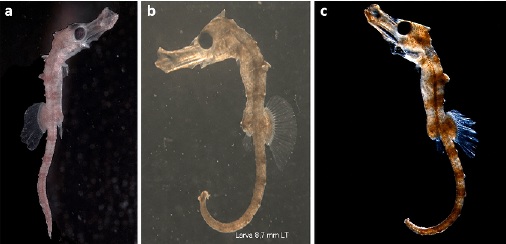
The findings of Hippocampus ingens in Ecuadorian waters are reported, obtained from ichthyoplankton samples in the province of Santa Elena. The first and second reports of this species were made in October 2013 and November 2014. The species was subsequently included in the Ecuadorian fish larvae identification catalog in 2018; a third organism was recorded in July 2025. The presence of this species in the same area could suggest a potential
nursery area. This finding contributes to the knowledge of larval biodiversity in the region and highlights the need for further studies on its early ecology and conservation, since it is considered Vulnerable by the IUCN and listed in CITES.
References
Beltrán-León, B.S. & Ríos, R. (2000–2001). Atlas de huevos y larvas de peces del Pacífico colombiano. INVEMAR, Serie de Publicaciones Especiales, 137 p.
Calderón, C. y Ayora, G. (2018). Atlas de identificación de estadios tempranos de peces del Pacífico ecuatoriano. Editorial Grupo Compás, Guayaquil. 152 p.
Calderón, G., Ayora, G. y Elías E. (2021). Guías ilustradas de ictioplancton del Pacífico ecuatoriano. Instituto Público de Investigación de Acuicultura y Pesca (IPIAP).
CITES. (2002). Amendments to Appendices I and II of CITES adopted at the 12th meeting of the Conference of the Parties (Santiago, Chile, 2002).
https://cites.org/eng/cop/12/prop/index.php
De la Cruz-Agüero J., Arellano-Martínez M., Cota-Gómez V. M. y De la Cruz-Agüero G. 1997. Catálogo de los peces marinos de Baja California Sur. CICIMAR-IPN. México. 341 pp.
Foster, S.J. & Vincent, A.C.J. (2004). Life history and ecology of seahorses: Implications for conservation and management. Journal of Fish Biology, 65(1): 1–61.
IUCN. (2023). Hippocampus ingens. The IUCN Red List of Threatened Species 2023, e.T10074A54904043.
Lourie, S.A., Foster, S.J., Cooper, E.W.T. & Vincent, A.C.J. (2004). A guide to the identification of seahorses. Project Seahorse.
Matarese, A.C., Kendall, A.W. Jr., Blood, D.M. & Vinter, B.M. (1989). Laboratory guide to early life history stages of northeast Pacific fishes. NOAA Technical Report NMFS, 80: 1-652.
Moser, H.G. (1996). The early stages of fishes in the California Current region. CalCOFI Atlas, 33: 1-1505.
Palma, A. y Meza, J. (2008). Distribución de Hippocampus ingens en la costa norte de Chile. Revista de Biología Marina y Oceanografía, 43(3): 633–638.
Reyes-Bustamante, H., Martínez, J. & Galván, C. (1999). Cultivo del caballito de mar Hippocampus ingens Girard en condiciones de laboratorio. Revista de Biología Tropical, 47(4): 1069–1073.
Richards, W.J. (2006). Early stages of Atlantic fishes: An identification guide for the western central North Atlantic. CRC Press. 2640 p.
Smith, P.E. & Richardson, S.L. (1979). Standard techniques for pelagic fish egg and larva surveys. FAO Fisheries Technical Paper, 175: 1-100.
Teixeira R. L. y Musick J. A. 2001. Reproduction and food habits of the lined seahorse, Hippocampus erectus (Teleostei: Syngnathidae) of Chesapeake bay, Virginia. Revista Brasileira de Biologia. 6(1):79-90.
Downloads
Published
Issue
Section
License
Copyright (c) 2026 jose rodrigo moreno vera, Gabriela Ayora-Macias, Gregoria Calderon-Peralta

This work is licensed under a Creative Commons Attribution-NonCommercial-ShareAlike 4.0 International License.