Hydrilla invasion threatening Colombia’s largest coastal wetland
DOI:
https://doi.org/10.25268/bimc.invemar.2026.55.2.1420Keywords:
Caribbean, Ciénaga Grande de Santa Marta, Hydrilla verticillata, invasive macrophytes, remote sensing.Abstract
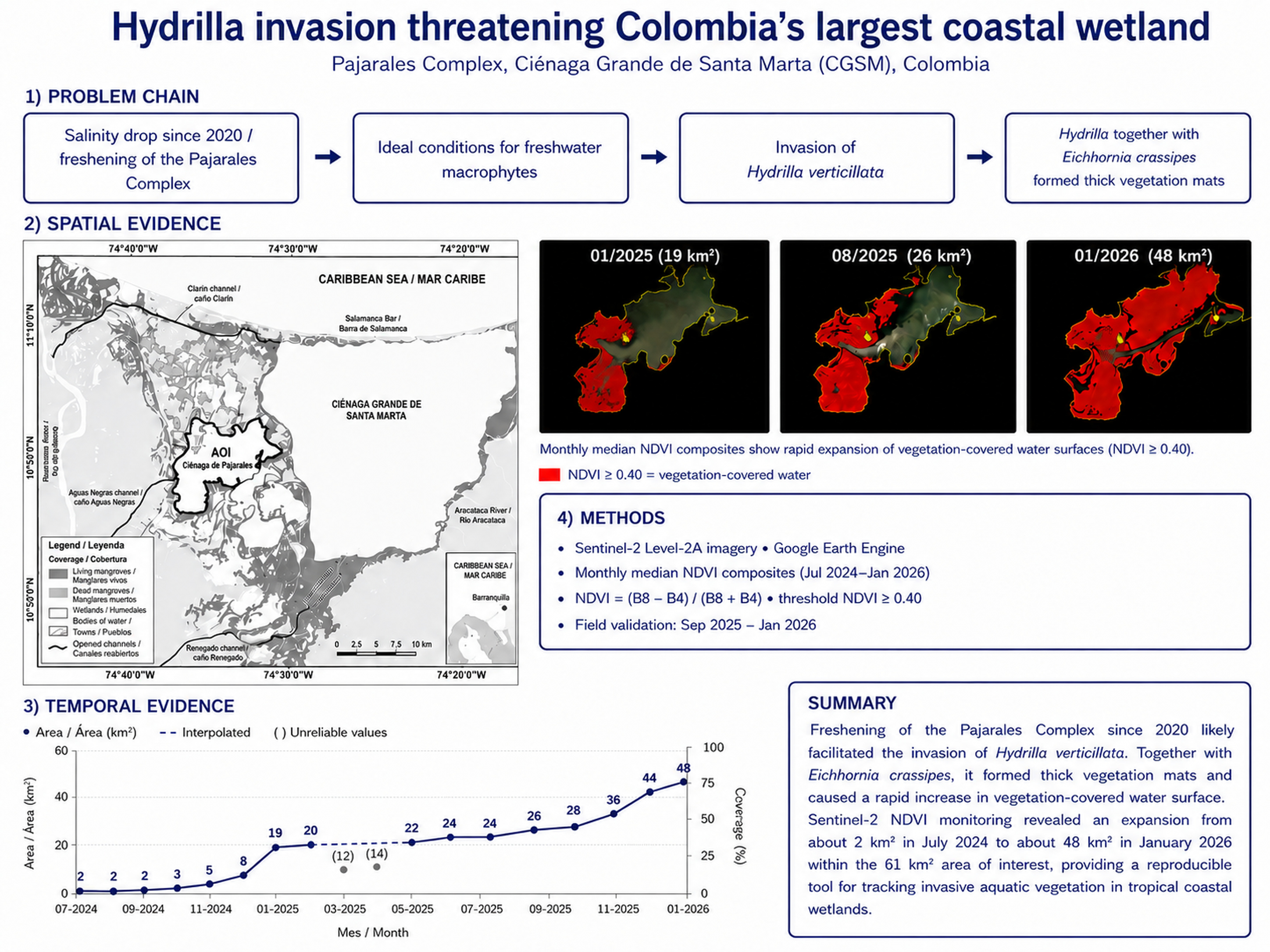
The Ciénaga Grande de Santa Marta (CGSM), Colombia's largest coastal wetland, has been monitored for more than 25 years due to its high ecological and socioeconomic importance. Since 2020, a freshening process has been observed that likely facilitated the recent invasion of the aquatic macrophyte Hydrilla verticillata in the Pajarales Complex, the only subsystem
where this invasion has been documented so far.
This study presents a rapid and quantitative assessment of the spatial and temporal expansion of aquatic vegetation using Sentinel-2 imagery and Google Earth Engine. Monthly NDVI composites were generated for the period July 2024–January 2026, classifying water surfaces with NDVI ≥ 0.40 as vegetation-covered.
Vegetation cover increased from less than 2 km² in July 2024 to more than 48 km² in January 2026 within a study area of approximately 60.7 km². Field verification conducted between September 2025 and January 2026 confirmed that the detected vegetation mainly corresponded to dense stands of H. verticillata and Eichhornia crassipes. The applied workflow provides a
reproducible approach for monitoring invasive aquatic vegetation in tropical coastal wetlands. VER VIDEO
References
Cheruiyot, E. K., Mito, C., Menenti, M., Gorte, B., Koenders, R. and Akdim, N. (2014). Evaluating MERIS-Based Aquatic Vegetation Mapping in Lake Victoria. Remote Sensing, 6(8), pp. 7762-7782. https://doi.org/10.3390/rs6087762
Cho, H. J., Kirui, P. and Natarajan, H. (2008). Test of Multi-spectral Vegetation Index for Floating and Canopy-forming Submerged Vegetation. International Journal of Environmental Research and Public Health, 5(5), pp. 477-483. https://doi.org/10.3390/ijerph5050477
Google Earth (2026). High-resolution satellite imagery of Nueva Venecia, Ciénaga de Pajaral, Colombia. Imagery © CNES/Airbus, acquisition dates 19 January 2022–9 December 2023. https://earth.google.com
Hofstra, D.E., Claytonb, J., Greena, J.D. and Augera, M. (1999). Competitive performance of Hydrilla verticillata in New Zealand. Aquatic Botany 63: pp. 305 - 324
Invemar. (2024). Monitoreo de las condiciones ambientales y los cambios estructurales y funcionales de las comunidades vegetales y de los recursos pesqueros durante la rehabilitación de la Ciénaga Grande de Santa Marta. Informe Técnico Final 2023 23; Santa Marta: Invemar, p. 185. https://www.invemar.org.co/documents/37438/390230/ITF+CGSM+2024.pdf/e9fd6a92-8907-97aa-1cd8-c2d304277f1b?t=1739220946728
Karakus, P. (2025). Detection of water surface using Canny and Otsu threshold methods with machine learning algorithms on Google Earth Engine: A case study of Lake Van. Applied Sciences, 15(6), pp. 2903. https://doi.org/10.3390/app15062903
Kumar, A., Cooper, C., Remillard, C., Ghosh, S., Haney, A., Braun, F., Conner, Z., Page, B., Boyd, K., Wilde, S. and Mishra, D. (2019). Spatiotemporal monitoring of Hydrilla (L. f.) Royle to aid management actions. Weed Technology, 33, pp. 1-12. https://doi.org/10.1017/wet.2019.13
Langeland, K.A. (1996). Hydrilla verticillata (L.f.) Royle (Hydrocharitaceae), “The perfect aquatic weed”. Castanea 61, pp.293–304.
McFeeters, S. K. (1996). The use of the Normalized Difference Water Index (NDWI) in the delineation of open water features. International Journal of Remote Sensing, 17(7), pp. 1425-1432. https://doi.org/10.1080/01431169608948714
Ortuño López, G., (2026). La planta invasora que avanza en silencio y pone en alerta a la Ciénaga Grande, el humedal costero más importante de Colombia. Mongabay. [online] Available at: https://es.mongabay.com/2026/01/planta-invasora-colombia-cienaga-grande/
Otsu, N. (1979). A threshold selection method from gray-level histograms. IEEE Transactions on Systems, Man, and Cybernetics, 9(1), pp. 62–66.
Salzwedel, H. (2025). Régimen hídrico Ciénaga Grande de Santa Marta - Hydrilla verticillata. CEMarin. https://cemarin.org/es/regimen-hidrico-cienaga-grande-de-santa-marta/
Salzwedel, H., Mejía-Rentería, C. and Mancera, J. (2025). Sz-Col/CGSM: NDVI-based aquatic vegetation monitoring – Complejo Pajarales (CGSM, Colombia) [Computer software]. Zenodo. https://doi.org/10.5281/zenodo.17594501
Shrivastava, M. and Srivastava, S. (2021). Application and research progress of Hydrilla verticillata in ecological restoration of water contaminated with metals and metalloids. Environmental Challenges 4:100177.
Downloads
Published
Issue
Section
License
Copyright (c) 2026 Horst Salzwedel, Juan Carlos Mejía-Rentería, José Ernesto Mancera Pineda

This work is licensed under a Creative Commons Attribution-NonCommercial-ShareAlike 4.0 International License.