Contenido de L-arginina en mariscos: revisión sistemática de su valor nutricional y proyecciones para la salud pública
DOI:
https://doi.org/10.25268/8dgbrb52Palabras clave:
óxido nítrico, metabolismo de aminoácidos, alimentos funcionales, salud cardiometabólica, biodisponibilidad de nutrientesResumen
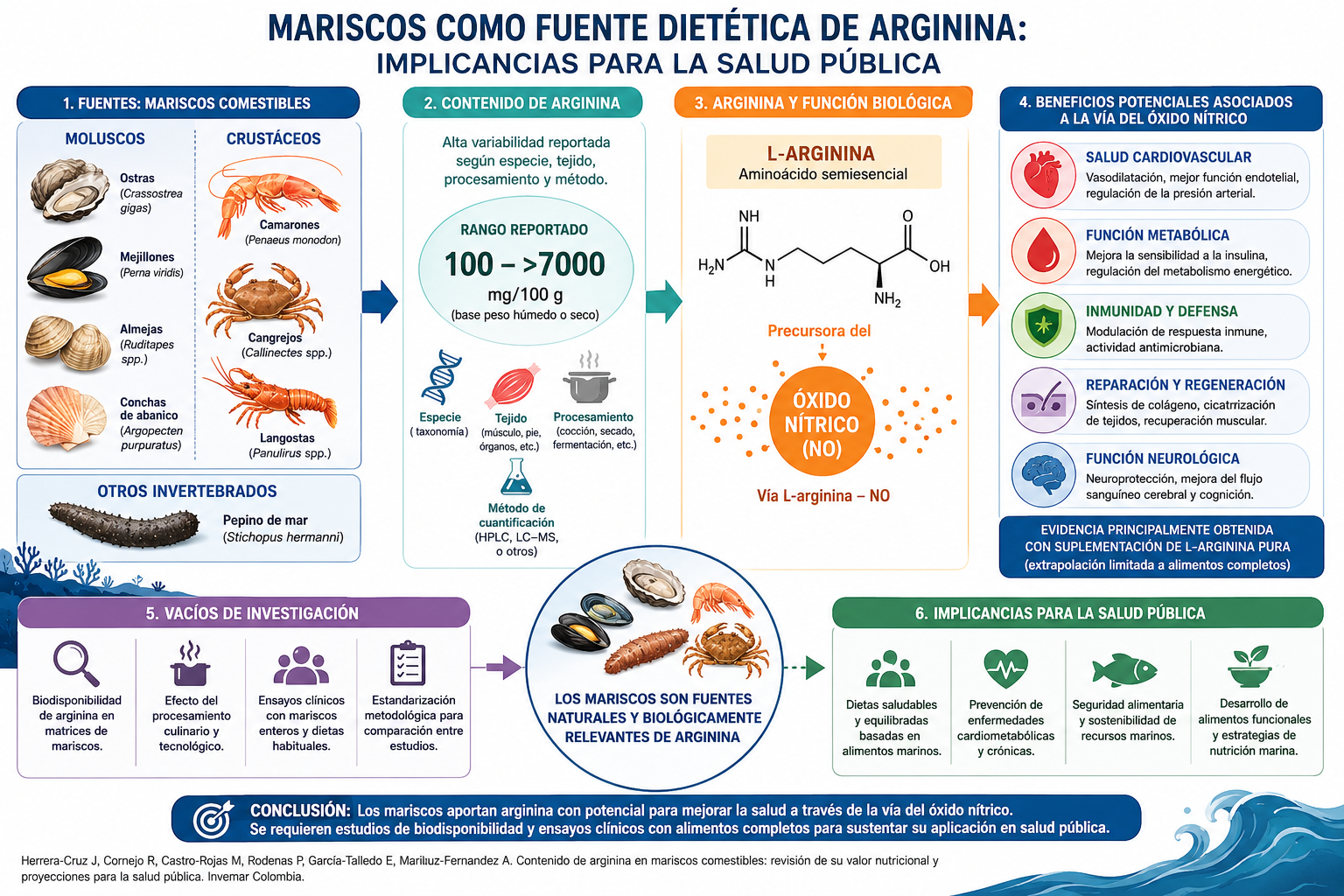
La L-arginina, aminoácido clave en la síntesis de óxido nítrico, presenta efectos vasodilatadores, inmunomoduladores y metabólico, su consumo dietético a través de mariscos comestibles representa una fuente natural prometedora, existen vacíos en cuanto a biodisponibilidad, sinergias nutricionales y evidencia clínica de sus beneficios funcionales. El objetivo de la investigación fue integrar críticamente la literatura científica disponible sobre el contenido y el potencial funcional de la L-arginina en mariscos comestibles, evaluando su valor nutricional, beneficios clínicos emergentes y delimitando vacíos de evidencia y áreas prioritarias para futuras investigaciones nutricionales y clínicas con enfoque en salud pública. Se realizó una revisión sistemática bajo lineamientos PRISMA y enfoque PSALSAR, recuperando 42 estudios desde Scopus. Se aplicó codificación temática con Atlas.ti 23, categorizando hallazgos por tipo de especie, concentración de L-arginina y dominios fisiológicos, la síntesis incluyó análisis de coocurrencia y triangulación mediante memos analíticos. Se identificaron especies con alto contenido de L-arginina, como Crassostrea gigas y Portunus sanguinolentus, los beneficios fisiológicos se agruparon en cinco dominios: cardiovascular, inmunológico, metabólico, regenerativo y neurológico; se evidenció gran heterogeneidad metodológica, falta de estudios clínicos con mariscos enteros. El estudio confirmó el potencial funcional de la L-arginina en mariscos, destacó su aplicabilidad nutricional y propuso una agenda de investigación translacional que articule nutrición marina y salud pública.
Referencias
Ahmed, HO, Mahdy, A., Nasser, SAM, Abd El-Wakeil, KF, Obuid-Allah, AH and Hassan, MM. (2022). Biochemical composition of some Echinodermata (Holothuroidea, Echinoidea) from the Red Sea, Egypt. Brazilian Journal of
Biology, 82:e246309. https://doi.org/10.1590/1519-6984.246309
Böger RH and Bode-Böger SM. (2001). The clinical pharmacology of L-Arginine. Annual Review of Pharmacology and Toxicology, 41(1): pp. 79–99. https://doi.org/10.1146/annurev.pharmtox.41.1.79
Bronte, V. and Zanovello, P. (2005). Regulation of immune responses by L-arginine metabolism. Nature Reviews Immunology, 5(8), pp.641–654. doi:https://doi.org/10.1038/nri1668.
Buzdağli, Y., Canyurt, F., Raşit Inaç, M., Ozan, M., Çağlar, B. and Köse, D.(2026). Effects of L-Theanine and L-Arginine supplementation on attention, cognitive, and shooting performance in elite air rifle shooters. International Journal of Sport and Exercise Psychology, pp. 1–21. https://doi.org/10.1080/1612197X.2026.2637018
Casonatto, J., Zago, D. M., Enokida, D. M., Grandolfi, K. and Aguiar, A. F. (2019). L-arginine supplementation improves post-exercise hypotension in elderly women. Revista Brasileira de Medicina do Esporte, 25(4): pp. 333–337.
doi: https://doi.org/10.1590/1517-869220192504182865
Chanmuang, S., Meemalai, O., Promyo, K., Park, KH, Pongworn, S., Gong, DS and Ham, KS. (2020). Ameliorative effects of ark clams (Scapharca subcrenata and Tegillarca granosa) on endothelial dysfunction induced by a high-fat diet. Applied Biological Chemistry, 63(1):73. doi: https://doi.org/10.1186/s13765- 020-00556-4
Citrangulo, G.L., Fonseca, A.L.S. da, Diniz, P.V., Rodrigues, J.P.T.N. and Drumond, D.G. (2022). Is arginine supplementation effective in preventing preeclampsia in pregnant women? Medicina (Ribeirão Preto), 55(1). doi:https://doi.org/10.11606/issn.2176-7262.rmrp.2022.184348.
Corbin, J. and Strauss, A. (2008). Basics of qualitative research: Techniques and procedures for developing grounded theory. Thousand Oaks, CA: SAGE de Castro Barbosa, T., Jiang, L.Q., Zierath, J.R. and Nunes, M.T. (2013).
L-Arginine enhances glucose and lipid metabolism in rat L6 myotubes via the NO/ c-GMP pathway. Metabolism, 62(1), pp.79–89. doi:https://doi.org/10.1016/j.metabol.2012.06.011.
de Luis, D., Izaola, O., De la Fuente, B and Aller, R. (2014). Effect of l-arginine supplementation on insulin resistance and adipocitokines levels in head and neck cancer non diabetic patients after surgery. Nutrición Hospitalaria, 30(4), pp. 870-875. https://dx.doi.org/10.3305/nh.2014.30.4.7864
Ene, C.D., Penescu, M., Nicolae, I. and Capusa, C. (2024). The role of the L-Arginine–Nitric oxide molecular pathway in autosomal dominant polycystic kidney disease. Journal of Personalized Medicine, 14(3), pp.299–299. doi:https://doi.org/10.3390/jpm14030299.
Epstein, F.H., Moncada, S. and Higgs, A. (1993). The L-Arginine-Nitric oxide pathway. New England Journal of Medicine, 329(27), pp.2002–2012. doi: https://doi.org/10.1056/nejm199312303292706
Ferrerira de Lima, F., Feitosa da Silva, T., Miranda Neto, M., Tavares Toscano, L., Oliveira da Silva, C.S. and Sérgio Silva, A. (2018). Effect of L-arginine intake on exercise-induced hypotension. Nutrición Hospitalaria, 35(5), pp.1195–1195. doi:https://doi.org/10.20960/nh.1708.
Galal, H. M., Abdelhafez, A. T., Sayed, M. M., Gomaa, W. M., Tohamy, T. A., Gomaa, A. M. and El-Metwally, T. H. (2024). Impact of L-Arginine on
diabetes-induced neuropathy and myopathy: Roles of PAI-1, Irisin, oxidative stress, NF-κβ, autophagy and microRNA-29a. Tissue and Cell, 87:102342. doi:https://doi.org/10.1016/j.tice.2024.102342
Gao, Y., Lu, J., Wang, Z., Sun, N., Wu, B., Han, X., Liu, Y., Yu, R., Xu, Y., Han, X. and Miao, J. (2024). L-arginine attenuates Streptococcus
uberis-induced inflammation by decreasing miR155 level. International Immunopharmacology, 130, p.111638. doi: https://doi.org/10.1016/j.intimp.2024.111638.
Geravand, S., Karami, M., Hedayat Sahraei and Rahimi, F. (2023). Protective effects of L-arginine on Alzheimer’s disease: Modulating hippocampal nitric oxide levels and memory deficits in aluminum chloride-induced rat model. European Journal of Pharmacology, 958, pp.176030–176030. doi:https:// doi.org/10.1016/j.ejphar.2023.176030.
Hambrecht, R., Wolf, A., Gielen, S., Linke, A., Hofer, J., Erbs, S., Schoene, N. and Schuler, G. (2000). Effect of exercise on coronary endothelial function in patients with coronary artery disease. New England Journal of Medicine, 342(7), pp.454–460. doi: https://doi.org/10.1056/nejm200002173420702.
Hernández Flores J. (2013). Caracterización bioquímica de la arginina cinasa del camarón blanco Litopenaeus vannamei y su participación en la fosforilación de nucleótido. Tesis maestría, Centro de Investigación en Alimentación y Desarrollo, A.C. https://ciad.repositorioinstitucional.mx/jspui/handle/1006/334
Hernández-Jiménez, C., Baltazares-Lipp, M., Olmos-Zúñiga, J.R., GaxiolaGaxiola, M., Guzmán-Cedillo, A.E., Silva-Martínez, M. y Jasso-Victoria, R. (2020). Efecto del pretratamiento con L-arginina en un modelo experimental de síndrome de insuficiencia respiratoria aguda inducido por ácido oleico. NCT Neumología y Cirugía de Tórax, 79(4), pp.236–247. doi: https://doi.org/10.35366/97966.
Herrera-Guardiola, S. y Valencia, M.E. (2021). Andamios de quitosano con L-Arginina para su aplicación en salud dental. Revista Nacional
de Odontología, 17(2), pp.1–21. doi:https://doi.org/10.16925/2357-4607.2021.02.07.
Huan, F., Han, T.-J., Liu, M., Li, M.-S., Yang, Y., Liu, Q.-M., Lai, D., Cao, M.-J.and Liu, G.-M. (2021). Identification and characterization of Crassostrea angulata arginine kinase, a novel allergen that causes cross-reactivity among shellfish. Food & Function, 12(20), pp.9866–9879. doi:https://doi.org/10.1039/d1fo02042k
Huan, F., Gao, S., Gu, Y., Li, Y.-P., Huang, X.-Y., Liu, M., Yang, Y., Lai, D., Xiao, A.-F. and Liu, G.-M. (2026). Designing a hypoallergenic mutant of Cra a 2 with T-Cell reactivity. Journal of Agricultural and Food Chemistry, 74(6), pp.5706–5717. doi: https://doi.org/10.1021/acs.jafc.5c15182.
Huerta Ojeda, Á., Domínguez de Hanna, A. and Barahona-Fuentes, G. (2019). The effect of supplementation with L-arginine and L-citrulline on physical performance: a systematic review. Nutrición Hospitalaria, 36(6), pp.1389-1402. doi:https://doi.org/10.20960/nh.02478.
Jeyasanta K and Patterson J. (2017). Effect of formulated feed on the biochemical composition of cultured shrimp, Penaeus monodon (Fabricius, 1798). International Journal of Fisheries and Aquatic Research, 2(1): pp.15–22
Jia, J., Guo, J., Yan, C., Gu, Y. and Xia, X.2025. Oyster powder supplementation enhances immune function in mice partly through modulating the gut microbiota and arginine metabolism. Food Function, 16(4): pp.1254–1266. doi: https://doi.org/10.1039/D4FO06068G
Kurhaluk N. (2023). The effectiveness of L-arginine in clinical conditions associated with hypoxia. International Journal of Molecular Sciences, 24(9):8205. https://doi.org/10.3390/ijms24098205
Lee YL and Lee SY. (2022). Effect of fermented oyster (Crassostrea gigas) extracts and regular walking on muscle strength and mass in older adults with relatively low muscle mass: A randomized controlled trial. Frontiers in Nutrition, 9:935395. doi: https://doi.org/10.3389/fnut.2022.935395
Li, M., Wen, H., Huang, F., Wu, M., Yu, L., Jiang, M. and Tian, J. (2022). Role of arginine supplementation on muscular metabolism and flesh quality of Pacific white shrimp (Litopenaeus vannamei) reared in freshwater. Frontiers in Nutrition, 9:980188. doi: https://doi.org/10.3389/fnut.2022.980188
Loppies, C.R.M., Apituley, D.A.N. and Tentua, E. (2021). Nutrition content and amino acid profile of paper squid (Loligo edulis). IOP Conference Series: Earth and Environmental Science, 797(1), p.012020. doi: https://doi.org/10.1088/1755-1315/797/1/012020.
Luiking, Y.C., Engelen, M.P. and Deutz, N.E. (2010). Regulation of nitric oxide production in health and disease. Current Opinion in Clinical Nutrition and Metabolic Care, 13(1), pp.97–104. doi:https://doi.org/10.1097/mco.0b013e328332f99d.
Maxwell, AJ, Ho, HKV, Le, CQ, Lin, PS, Bernstein, D. and Cooke, JP (2001). l -Arginine enhances aerobic exercise capacity in association with augmented nitric oxide production. Journal of Applied Physiology, 90(3): pp. 933–938. doi:https://doi.org/10.1152/jappl.2001.90.3.933
Mengist, W, Soromessa, T and Legese, G. (2020). Method for conducting systematic literature review and meta-analysis for environmental science research. MethodsX. 7:100777. https://doi.org/10.1016/j.mex.2019.100777
Mohanty, B., Mahanty, A., Ganguly, S., Sankar, T.V., Chakraborty, K., Rangasamy, A., Paul, B., Sarma, D., Mathew, S., Asha, K.K., Behera, B., Aftabuddin, M., Debnath, D., Vijayagopal, P., Sridhar, N., Akhtar, M.S., Sahi, N., Mitra, T., Banerjee, S. and Paria, P. (2014). Amino acid compositions of 27 food fishes and their importance in clinical nutrition. Journal of Amino Acids, pp.1–7. doi:https://doi.org/10.1155/2014/269797.
Monti, LD, Casiraghi, MC, Setola, E., Galluccio, E., Pagani, MA, Quaglia, L., ...and Piatti, P. (2013). l-Arginine enriched biscuits improve endothelial function and glucose metabolism: A pilot study in healthy subjects and a cross-over study in subjects with impaired glucose tolerance and metabolic syndrome. Metabolism. 62(2):255–264. doi: https://doi.org/10.1016/j.metabol.2012.08.004
Page, M.J., McKenzie, J.E., Bossuyt, P.M., Boutron, I., Hoffmann, T.C., Mulrow, C.D., Shamseer, L., Tetzlaff, J.M., Akl, E.A., Brennan, S.E., Chou, R., Glanville, J., Grimshaw, J.M., Hróbjartsson, A., Lalu, M.M., Li, T., Loder, E.W., Mayo-Wilson, E., McDonald, S. and McGuinness, L.A. (2021). The PRISMA 2020 statement: An updated guideline for reporting systematic reviews. British Medical Journal, 372(71). doi: https://doi.org/10.1136/bmj.n71.
Piatti, P., Monti, L.D., Valsecchi, G., Magni, F., Setola, E., Marchesi, F., Galli-Kienle, M., Pozza, G. and Alberti, K.G.M.M. (2001). Long-term oral l-Arginine administration improves peripheral and hepatic insulin sensitivity in type 2 diabetic patients. Diabetes Care, 24(5), pp.875–880. doi: https://doi.org/10.2337/diacare.24.5.875.
Popovic, P.J., Zeh, H.J. and Ochoa, J.B. (2007). Arginine and immunity. The Journal of Nutrition, 137(6), pp.1681S1686S. doi: https://doi.org/10.1093/jn/137.6.1681s.
Porto, A. A., Gonzaga, L. A., Benjamim, C. J. R., Garner, D. M., Adami, F. and Valenti, V. E. (2022). Effect of oral l-arginine supplementation on postexercise blood pressure in hypertensive adults: A systematic review with meta-analysis of randomized double-blind, placebo-controlled studies. Science & Sports, 37(7): pp. 552–561. https://doi.org/10.1016/j.scispo.2021.04.003
Posso Pacheco, R.J., Barba Miranda, L.C., Tenorio Sánchez, R.A., Caicedo Quiroz, R., Maqueira-Caraballo, G. and Barzola-Monteses, J. (2025). PRISMA guidelines: Methodological adaptation for systematic reviews in education. Data and Metadata, 4, p.698. doi: https://doi.org/10.56294/dm2025698.
Prastya, M. E., Astuti, R. I., Batubara, I., Takagi, H. and Wahyudi, A. T. (2020).Natural extract and its fractions isolated from the marine bacterium Pseudoalteromonas flavipulchra STILL-33 have antioxidant and antiaging activities in Schizosaccharomyces pombe. FEMS Yeast Research, 20(3), foaa014.doi:https://doi.org/10.1093/femsyr/foaa014
Rodan, L.H., Poublanc, J., Fisher, J.A., Sobczyk, O., Mikulis, D. and Tein, I. (2020). L-arginine effects on cerebrovascular reactivity, perfusion and neurovascular coupling in MELAS (mitochondrial encephalomyopathy with lactic acidosis and stroke-like episodes) syndrome. PLoS ONE, 15(9), pp.e0238224–e0238224. doi: https://doi.org/10.1371/journal.pone.0238224.
Saka, W.A., Anigbogu, C.N., Kehinde, M.O. and Jaja, S.I. (2023). L-Arginine supplementation enhanced expression of glucose transporter (GLUT 1) in sickle cell anaemia subjects in the steady state. Current Research in Physiology, 6, p.100096. doi:https://doi.org/10.1016/j.crphys.2022.11.003.
Salvatore, P., Casamassimi, A., Sommese, L., Fiorito, C., Ciccodicola, A., Rossiello, R., Avallone, B., Grimaldi, V., Costa, V., Rienzo, M., Colicchio, R., Williams-Ignarro, S., Pagliarulo, C., Prudente, M.E., Abbondanza, C., Lamberti, F., Baroni, A., Buommino, E., Farzati, B., Tufano, M.A., Ignarro, L.J. and Napoli, C. (2008). Detrimental effects of Bartonella henselae are counteracted by l -arginine and nitric oxide in human endothelial progenitor cells. Proceedings of the National Academy of Sciences, 105(27): pp. 9427–9432. doi:https://doi.org/10.1073/pnas.0803602105
Sarandy, MM, Pelinsari, SM, de Souza, LM, Novaes, RD, Zanuncio, VV, and Gonçalves, RV. (2023). l-arginine and l-citrulline supplementation accelerates second intention wound healing in iNOS knockout mice. Journal of Functional Foods. 100:105395. doi: https://doi.org/10.1016/j.jff.2022.105395
Sarwar Gilani G, Wu Xiao C. and Cockell KA. (2012). Impact of antinutritional factors in food proteins on the digestibility of protein and the bioavailability of amino acids and on protein quality. The British Journal of Nutrition, 108(S2): pp. S315–S332. doi: https://doi.org/10.1017/S0007114512002371
Shiraseb, F., Asbaghi, O., Bagheri, R., Wong, A., Figueroa, A. and Mirzaei, K. (2022). Effect of l-Arginine supplementation on blood pressure in adults: A systematic review and dose–response meta-analysis of randomized clinical trials. Advances in Nutrition. 13(4): pp.1226–1242. doi: https://doi.org/10.1093/advances/nmab155
Smith, L. Arizza, V., Barela Hudgell, M., Barone, G., Bodnar, A., Buckley, K., Cunsolo, V., Dheilly, N.F., Nicola, F., Fugmann, S. Furukawa, R., García Arraras, J., Henson, J., Hibino, T., Irons, Z., Li, C.,Lun, C., Majeske, A., Oren, M., Pagliara, P., Pinsino, A., Raftos, D., Rast, J., Samasa, B., Schillaci, D., Schrankel, C., Stabili, L., Stensväg, K.and Sutton, E. (2018). Echinodermata: The complex immune system in echinoderms. In: Advances in Comparative Immunology. Springer International Publishing; pp. 409–501 [accessed2025 June 22]. https://link.springer.com/10.1007/978-3-319-76768-0_13. doi:https://doi.org/10.1007/978-3-319-76768-0_13
Suliburska, J., Bogdanski, P., Szulinska, M., Pupek-Musialik, D. and Jablecka, A. (2014). Changes in mineral status are associated with improvements in insulin sensitivity in obese patients following l-arginine supplementation. European Journal of Nutrition, 53(2): pp. 387–393. doi:https://doi.org/10.1007/s00394-013-0533-7
Tahvilian, R., Golesorkhi, M. A., Parhoudeh, F., Heydarpour, F., Hosseini, H., Baghshahi, H., Akbari, H., Reza Memarzadeh, M., Mehran, M. and Bagheri, H. (2024). The effect of the combination of ginseng, Tribulus terrestris, and L-arginine on the sexual performance of men with erectile dysfunction: a randomized, double-blind, parallel, and placebo-controlled clinical trial. Journal of Pharmacopuncture, 27(2): pp. 82–90. doi: HYPERLINK “https://doi/”https://doi. org/10.3831/KPI.2024.27.2.82
Thurgasri V, Timothy G. and Aemi Syazwani, A. (2023). Analyzing nutritional content and essential amino acid composition of Perna viridis mussels: Insights from proximate analysis and high-performance liquid chromatography-ultraviolet analysis. Proceedings Science Mathematics, 20: pp. 1–6.
Tsikas D. (2020). Urinary dimethylamine (DMA) and its precursor asymmetric dimethylarginine (ADMA) in clinical medicine, in the context of nitric oxide (NO) and beyond. Journal of Clinical Medicine, 9(6):1843. doi:https://doi.org/10.3390/jcm9061843
Vadillo-Ortega, F., Perichart-Perera, O., Espino, S., Avila-Vergara, M. A., Ibarra, I., Ahued, R., Godines, M., Parry, S., Macones, G. and Strauss, J.F. (2011). Effect of supplementation during pregnancy with L-arginine and antioxidant vitamins in medical food on pre-eclampsia in high risk population: randomised controlled trial. BMJ, 342(may19 1):d2901–d2901. doi:https://doi.org/10.1136/bmj.d2901
Wang Q, Xu, Z. and Ai, Q. (2021). Arginine metabolism and its functions in growth, nutrient utilization, and immunonutrition of fish. Animal Nutrition, 7(3): pp.716–727. doi:https://doi.org/10.1016/j.aninu.2021.03.006
Wu, G., Bazer, FW, Davis, TA, Kim, SW, Li, P., Marc Rhoads, J. and Yin, Y. (2009). Arginine metabolism and nutrition in growth, health and disease. Amino Acids, 37(1): pp.153–168. doi:https://doi.org/10.1007/s00726-008-0210-yWu, G., Bazer, FW, Dai, Z., Li, D., Wang, J. and Wu, Z. (2014). Amino acid nutrition in animals: Protein synthesis and beyond. Annual Review of Animal Biosciences, 2(1): pp.387–417. doi:https://doi.org/10.1146/annurevanimal-022513-114113
Xu, L., Wang, X., Wang, C., Li, W. and Liu, H. (2022). l-arginine supplementation improved neonatal outcomes in pregnancies with hypertensive disorder or intrauterine growth restriction: A systematic review and meta-analysis of randomized controlled trials. Clinical Nutrition, 41(7):1512–1522. doi:https://doi.org/10.1016/j.clnu.2022.05.014
Yan J, Guo Z and Xie J. (2024). A critical analysis of the opportunities and challenges of phage application in seafood quality control. Foods. 13(20):3282. doi: https:// doi.org/10.3390/foods13203282
Yu, H. R., Kuo, H. C., Huang, L. T., Chen, C. C., Tain, Y. L., Sheen, J. M. and Hsu, T. Y. (2014). l – Arginine modulates neonatal lymphocyte proliferation through an interleukin – 2 independent pathway. Immunology, 143(2): pp. 184–192. doi:https://doi.org/10.1111/imm.12300
Descargas
Publicado
Número
Sección
Licencia
Derechos de autor 2026 Jorge Herrera-Cruz, Rodolfo Cornejo Urbina, Miriam Castro-Rojas, Pedro Rodena, Enrique García-Talledo

Esta obra está bajo una licencia internacional Creative Commons Atribución-NoComercial-CompartirIgual 4.0.