DISTRIBUTION, ABUNDANCE AND FREQUENCY OF POTENTIAL TOXIGENIC PHYTOPLANKTON OF THE COLOMBIAN PACIFIC BASIN
DOI:
https://doi.org/10.25268/bimc.invemar.2016.45.1.635Keywords:
Harmful marine phytoplankton, Colombian Pacific.Abstract
In order to contribute to the knowledge of potentially toxigenic phytoplankton, the frequency, distribution and abundance of these organisms in samples from eleven cruises conducted in the Colombian Pacific basin from 2004 to 2011 is described. The research cruises were conducted under the Regional Study of the “El Niño” phenomenon in the Southeast Pacific (ERFEN), a multinational program of the Permanent Commission for the South Pacific (CPPS). Genera Pseudo-nitzschia, Dinophysis, Gonyaulax, and Alexandrium are remarkable in the results because of their wide distribution, persistence and abundance. These species have been reported to cause amnesic intoxications (Pseudonitzschia), diarrhea (Dinophysis and Gonyaulax), and paralytic poisoning (Alexandrium). Although some of these species were abundant in the plankton, there were not obvious changes in water coloration or reports of adverse effects during the study period.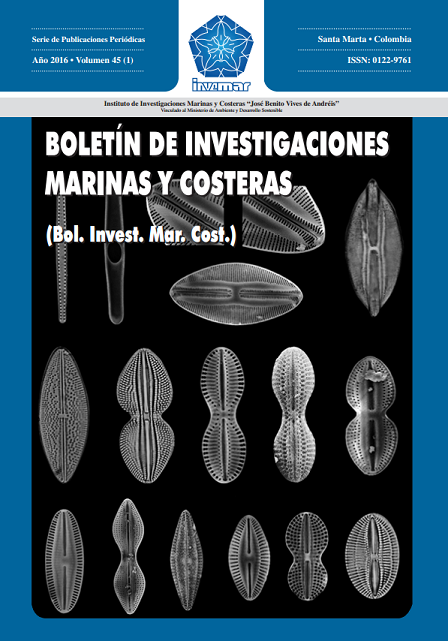
Downloads
Published
2016-01-01
Issue
Section
Scientific Notes
License
Copyright (c) 2016 Bulletin of Marine and Coastal Research

This work is licensed under a Creative Commons Attribution-NonCommercial-ShareAlike 4.0 International License.
How to Cite
1.
DISTRIBUTION, ABUNDANCE AND FREQUENCY OF POTENTIAL TOXIGENIC PHYTOPLANKTON OF THE COLOMBIAN PACIFIC BASIN. Bol. Investig. Mar. Costeras [Internet]. 2016 Jan. 1 [cited 2026 Aug. 11];45(1). Available from: https://boletin.invemar.org.co/index.php/boletin/article/view/635